
Capital: Prague … 10,860,000 People … 78,871 km² 
The Country
The Czech Republic, also known as Czechia, is a landlocked country at the heart of Central Europe. Known for its fairy-tale castles, medieval towns and iconic red-roofed skylines, the Czech Republic is a country where centuries of history meet an easygoing modern charm.
Fun Facts
The Czech Republic drinks the most beer per capita in the world.
With over 2,000 castles, the country has the highest density of castles in Europe.
Sugar cubes were invented in the Czech Republic in the 1840’s
My Experience
Day 1
After a train delay in Vienna turned into a train cancellation (leading to a second missed train, leading to booking a different route), my friend Karan and I inched through the Czech countryside on perhaps the most worlds slowest train - although we were gifted a box of cookies by the train company as a small consolidation for our troubles.
Hours after we were supposed to arrive, we exhaustedly stumbled off the train at Praha hlavní nádraží, Prague’s main train station.
Taking a cab into old town, we met with our two other friends, Romi and Joey. Although a few hours later than expected, the euro trip had begun.
Walking through the narrow cobblestone streets as the sun began to set, we wound our way past uneven stone facades, small eateries and lively bars. The air had that early-evening mix of chimney smoke and cold river breeze, and every turn seemed to open onto another postcard-ready alley. Eventually we reached Hemingway Bar, one of Prague’s most well-known cocktail spots. Inside, the lights were low, and bartenders were creating very unique drinks, including a signature cocktail served in a small metal gasoline canister (a novelty that tasted nothing like gasoline, thankfully).
After months of planning and organizing against four busy schedules, it was a fantastic feeling to finally talk in person.
We all live in different cities, so seeing eachother is an unfortunately rare occurrence. Having a drink and conversing while tucked into a corner of a bar in one of Europe’s oldest cities immediately set the tone for a fantastic trip.
No longer exhausted, rejuvenated from good conversation, we took our bartenders recommendation and made our way to Vzorkovna Dog Bar - a sprawling, underground scene of interconnected rooms and bars that made the complex feel part nightclub, part art project, part bunker. We spent the next few hours trying Czech beer, trying out the punching bag, and discovering new rooms.
Before heading home, Romi recreated the iconic stair scene from The Joker on some secluded stone steps, and we partied with a mom and daughter duo working at a donair shop as they were closing up. Only a few hours in, and lifetime memories.
Day 2
Waking up bright and early (just kidding, waking up just before noon) it was time to see Prague in the daylight.
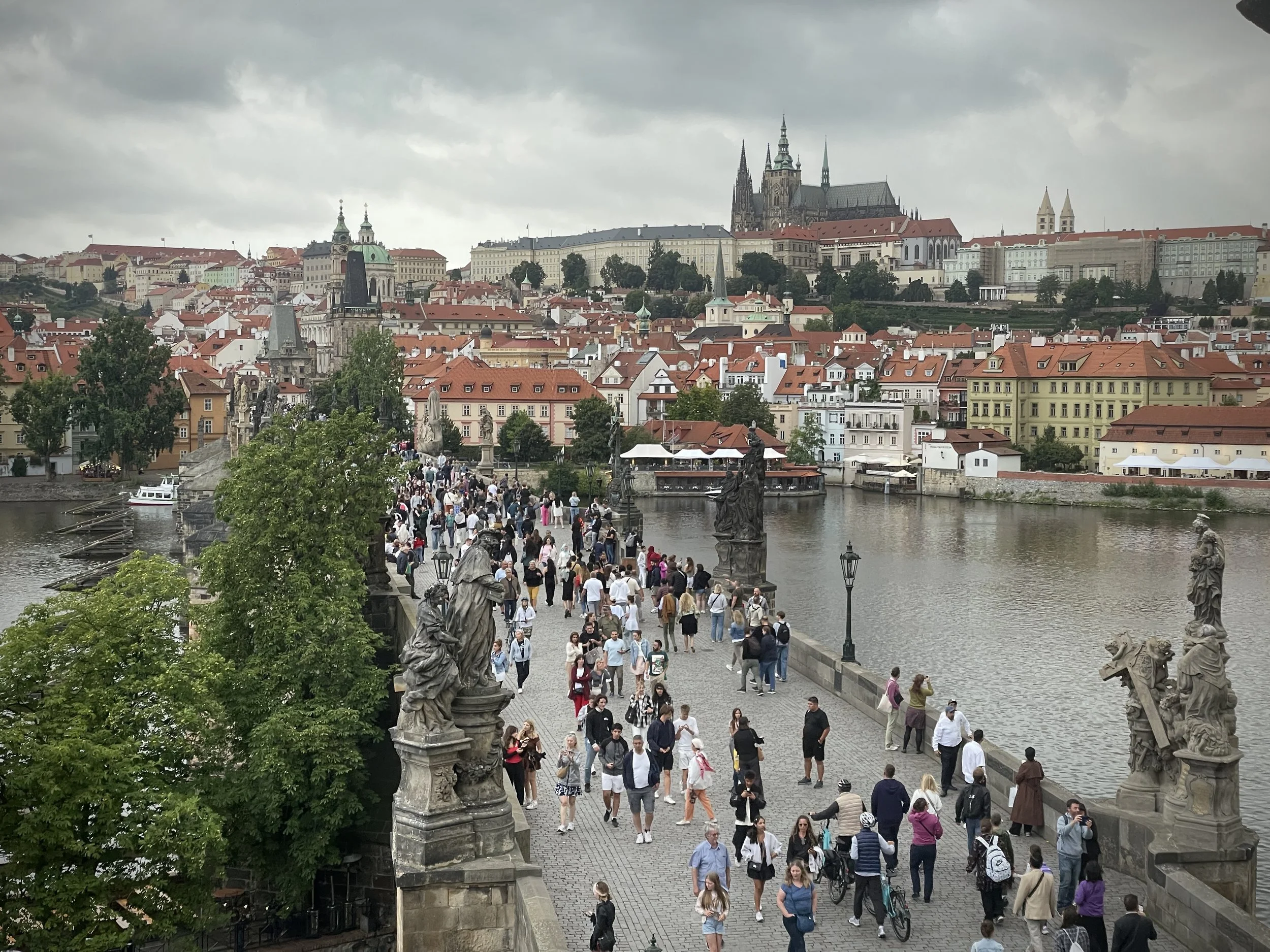
Our hotel, adorned with baroque frescos on the ceiling, was steps away from Charles Bridge. Commissioned by King Charles IV in the mid-14th century to replace the older Judith Bridge, which was destroyed by flood in 1342, construction of the Charles Bridge began in 1357 and took roughly 45 years to complete. It was the city’s only permanent crossing for centuries, connecting the Old Town with the Lesser Town and forming a key artery for trade.
Today, the bridge is like an open-air museum, featuring statues of saints turned black from centuries of soot and weather.
A noticeable exception, however, is a bright, almost glowing patch on the statue of St. John of Nepomuk.
Polished from years of visitors rubbing it for good luck, a small bronze dog shines through the darkened relief. Although there are 30 statutes along the bridge and crowds of tourists, this one dog seemed to garner the most attention.
On the Old Town side, the streets are tight and energetic; a mix of cafés, shops, and apartment windows stacked close together. There’s a constant hum: street musicians tuning guitars, groups drifting between bars, and the general pace of a neighbourhood that’s used to being busy.
On the Old Town side, the streets are tight and energetic — a mix of cafés, shops, and apartment windows stacked close together. There’s a constant hum: street musicians tuning guitars, groups drifting between bars, and the general pace of a neighbourhood that’s used to being busy. It feels lived-in, commercial, familiar.
But once you cross the bridge and pass under the Gothic tower on the Lesser Town side, the atmosphere changes immediately. The streets widen just enough to feel calmer, the crowds thin out, and the buildings shift from the sharper lines of Old Town to softer facades and pastel Baroque houses. The pace felt slower. Instead of shops and take-away windows, you start seeing old palaces, small squares, and steep paths leading up toward the castle. It’s still Prague, but the character felt different.
We stopped for breakfast at Cafe Savoy, first opened in 1893 as an elegant way to start the day. High ceilings, ornate moldings, and rows of vintage chandeliers give it a formal elegance.The menu is a careful mix of French‑style breakfast dishes, Czech classics, and decadent desserts. It was a departure from the vibe of Dog Bar the night before- cultural whiplash at its finest.
After breakfast, we walked along the banks of the Vltava River, enjoying the serenity. Streets were empty, and we often found ourselves by ourselves walking through medieval squares. It wasn’t until we reached the base of a long, winding staircase that we started seeing more people again; the path that would carry us up toward Prague Castle.
The steps climbed steadily, flanked by old walls and greenery, and with every turn, the city below gradually opened up, offering glimpses of the river, red rooftops, and the spires of churches rising above the skyline.
About halfway up the staircase, we found a small medieval themed pub: U Krále Brabantského. Outside, a sign labeled the establishment “the oldest pub in Prague since 1375”. It wasn’t just medieval themed, it was actually medieval.
Ducking inside, the pub was dark and had an enticing ambience of candlelight, smoke from a hearth and vaulted stone ceilings with darkened paintings on the walls. There were long wooden tables filled with guests stopping by for a pint, and we were pushed into an inviting table near one of the few windows in the bar.
Uninviting, however, was our server. She slammed our drinks down on the table and rolled her eyes when we had questions. What we later learned was the bar was intentionally abrasive; servers weren’t as nice back then, and they continue to be unapologetically authentic. We loved it. Other groups around us, not so much.
The pub is rumoured to have been frequented by kings of Bohemia through secret tunnels, as the bar is a stones throw away from Prague Castle. The heat of the day had started to taper off, so we decided now was a good opportunity to finish climbing the steps to the castle.
Prague Castle itself is one of the largest castle complexes in the world, with a history stretching back to the 9th century. Founded around 880 AD, it began as a fortified settlement for Bohemian princes and evolved over centuries into the seat of kings, emperors and presidents. Within its walls are palaces, churches, gardens and courtyards, each reflecting different architectural styles from Romanesque and Gothic to Baroque.
Up close, the grandeur is overwhelming. The massive courtyards, towering spires of St. Vitus Cathedral and thick fortification walls make it clear why this castle has dominated the city for more than a millennium. Every façade, every archway, and every stained glass window was deliberately monumental.
I’m grateful to say I’ve seen my fair share of European cathedrals, but St. Vitus cathedral was something else. The colours of the stained glass was incredibly vibrant, bathing the cathedral in a multicolour glow. Large, noisy crowds outside were quickly silenced when entering. Plus, it was a nice break from the heat.
Past the cathedral, the complex continued on and on; we walked through various buildings with paintings of past rulers and guided artifacts. Eventually, we walked trough the Golden Lane; a narrow, colorful street tucked inside the walls of the castle. The lane is lined with tiny, brightly painted houses, most no wider than a single room, their low ceilings and uneven floors making them feel almost toy-like from the outside. Originally built in the 16th century to house castle guards, later residents included goldsmiths, which gave the street its name, and over time, various artisans, writers, and alchemists.
At the end of the lane stood Daliborka Tower, a former prison tower at the edge of the complex. Down a damp, narrow staircase, we entered the old dungeon filled with torture devices, cramped prison cells and an oubliette: a pit where prisoners would be dropped down, forgotten, where they would inevitably starve to death. It was a room filled with a history of pain and misery, juxtaposed to the grandeur of cathedrals and royalty just above us.
Walking down and out of the castle walls, we walked back across the St. Charles Bridge towards Old Town. We stopped for a bite to eat at U Pivrnce, enjoying some traditional dishes surrounded by walls filled with drawings from Petr Urban, a well‑known Czech illustrator, cartoonist, and former Olympic luger.
Next, we found entry into the Anonymous Shrink's Office - a hidden, speakeasy style bar where your first drink is chosen based colourful rorschach tests. The bartenders were themselves anonymous, wearing masks and being intentionally cryptic. New rounds were decided based on different tests, which you’ll have to visit for yourself to experience (no spoilers here). We were able to soften-up one cryptic bartender, who let us sample some great Czech liquor (called something we promptly forgot).
After a brief stop at the casino, and after winning a few hands of blackjack, our pockets were filled with some newly acquired Czech Koruna. A night of bar hopping was upon us. We thought it was best to start where it all began- Dog Bar. It was there we made a few friends, where we eventually decided to go to a rooftop nightclub overlooking Prague. Time flew by, so much so that by the time we left, the sun was up. It was 5:15 a.m.
We walked the quiet, empty streets back to our hotel, falling into bed as the normal tourists began their days of sightseeing.
Day 3
Waking up bright and early (just kidding, waking up around 2 p.m.) we started the drizzly day by walking to Old Town Square, famous for its Astronomical Clock.
Known as Pražský orloj, the Astronimcal Clock is one of the city’s most iconic landmarks, and a centerpiece of the Old Town Hall in Old Town Square. Installed in 1410, it’s the third-oldest astronomical clock in the world and the oldest one still operating. The clock isn’t just a timepiece; it shows the position of the sun and moon, the zodiac, and even Prague’s old Bohemian time system. The ornate dial is surrounded by moving figures, including the Twelve Apostles, which parade on the hour, as well as symbolic statues like Death striking a bell.
One of the most enduring legends surrounding the clock involves its creator, Master Hanuš. The legend goes that the city council was so impressed (and fearful that Hanuš might replicate his masterpiece elsewhere) that they blinded him to prevent him from building another clock. In revenge, it’s said he sabotaged the mechanism so that no one could repair it properly for years.
Nearby the square, we took a break from the rain by wandering around the Sex Machines Museum - an interesting look at over 300 “devices” and artifacts, including some dating back 500+ years. It wasn’t on our initial list of things to do in Prague, but hey, history is history.
Aimlessly walking around is one of my favorite parts of travelling- and today was a perfect day for that. We walked around Old Town, stopping by local shops, before sitting down for dinner at Krčma - a snug, rustic basement serving hearty food. After the night before, that was ideal.
We enjoyed roasted pork knee (better than it sounds) and deep fried beer cheese (exactly as it sounds). The walls were dripping with red candle wax, and all the ambience of a dark basement filled with great food put us in good spirits.
That evening, after being surrounded by tales of torture and blinded click makers, we decided to go on a ghost tour to learn more about the spookier side of Prague’s history.
Our guide led us through tales of restless spirits, mysterious disappearances and old legends that had haunted the city for centuries. From abandoned courtyards to hidden passageways, each stop revealed another layer of Prague’s darker history, blending folklore with documented events.
What was a bit amusing, though, was the tour consisted mostly of young kids and their parent. One dad even asked why we joined a tour when we could be out drinking instead.
The tour culminated in an underground section of the city, accessed through a narrow stone stairway that led beneath the cobblestones we had walked on earlier. Down there, the air was cooler and damp, and the city life continued above.
Modern Prague is literally built on top of old Prague. Beneath the streets and buildings were medieval foundations, cellars, storage rooms, and passageways, some dating back hundreds of years. As part of this tour, we were able to walk through small sections of it. In the corner of one of the passageways, In a dim corner sat a large clay statue sat, inspired by the legend of the Golem — the clay creature from Jewish folklore said to protect the Prague ghetto.
Emerging back onto street level, we decided to take the dad’s advice and stop for a drink- our last drink in Prague. We knew our trip was going to be fast, but it really did fly by. The next day we were going to be hopping on a train to Vienna bright and early (actually bright and early). We discussed plans for the next day, paid our tabs and walked back through Old Town Square. The crowds at the astronomical clock earlier in the day had disappeared, and there were only a few sparse groups in the square.
Our time in Prague had unfortunately come to an end, but we managed to soak in the city’s essence: wandering winding streets, exploring centuries of history, taking in grand architecture and hidden corners, and experiencing both the playful and mysterious sides of the city. Every alley, bridge, and square seemed to carry a story, leaving us with a sense of Prague’s layered past and vibrant character. Next stop, Austria.
More Photos of the Czech Republic