
Capital: Budapest … 9,562,000 People … 93,026 km² 
The Country
Hungary is a Central European country located in the Carpathian Basin and bordered by seven nations. It is known for its historic cities, thermal water resources, and a distinctive cuisine. The capital, Budapest, sits along the Danube and acts as the country’s main cultural and economic hub.
Fun Facts
The Hungarian Parliament Building is one of the largest in Europe, with 691 rooms.
The Rubik’s Cube was invented in Hungary.
The Hungarian alphabet has 44 letters, including several unique accented vowels.
My Experience
Day 1
Sitting on the train from Slovakia, espresso in hand, watching the countryside drift by with my friends beside me, it was hard not to feel content. Rolling hills, small villages, and stretches of green flashed past as conversation and quiet moments filled the carriage. In just a few hours, we’d reach Budapest, the final leg of our four-country European journey. The continued anticipation of a new city made the ride feel just as exciting as the adventures we’d already had.
When we booked the trip, we couldn’t understand why hotels in Budapest were so much more expensive than in Prague or Vienna. Nearly double in price. At the time, we assumed it was simply because we were staying Friday through Monday. It wasn’t until just before our arrival that we realized the real reason: the Hungarian Grand Prix was happening that same weekend, and the city was packed with racing fans. We knew we were in for a lively, crowded, and exciting introduction to Budapest.
Leaving the train station, we wandered through streets that felt welcoming and lived-in, where the architecture carried a gentle aura of age. The façades were slightly faded, windows and balconies showing signs of daily life, but overall it felt warm and charming. It was the kind of place where the city’s history felt present without being over-polished. As we neared our hotel near St. Stephen’s Basilica, the streets shifted almost immediately. The slightly faded, lived-in charm gave way to a more upscale, polished atmosphere — boutique shops, elegant cafés, and well-maintained façades signaled we were entering the heart of Budapest’s historic and stylish center.
That evening, we made our way to Mazel Tov, a stylish restaurant tucked into Budapest’s Jewish Quarter. The area, known locally as District VII, has a layered history: once a densely populated hub for the city’s Jewish community, it faced near-total devastation during World War II and the Holocaust. Many synagogues, schools and homes were destroyed or repurposed, and the neighborhood fell into decline.
In recent years, the Jewish Quarter has been revitalized, blending historic charm with modern vibrancy. Mazel Tov itself occupies a courtyard that feels both intimate and lively, surrounded by high walls adorned with greenery and soft lights. You can sense the layers of history beneath the trendy restaurants and bars. We had a fantastic meal late into the evening.
After dinner, we wandered further into the Jewish Quarter, which is famous for its ruin bars- old abandoned buildings and courtyards transformed into eclectic, artsy nightlife spots. The most famous of them, Szimpla Kert, is a labyrinth of rooms filled with mismatched furniture, neon décor, and dozens of areas offering different experiences. From shisha bars to electronic dance floors, we navigated the Friday night crowds and discovered something unexpected everywhere we looked.
Late into the evening, as we were making our way back to the hotel, I finally tried Hungarian Lángos: a deep-fried flatbread, crispy on the outside and soft on the inside, traditionally topped with garlic, sour cream, and grated cheese. I simply don’t have the words to describe how much I love this dish. I ate it everyday we were in Hungary, and I’d eat it every day at home if I could.
Day 2
Waking up the next morning, we made our way to the New York Café, often hailed as the “most beautiful café in the world.” Opened in 1894 as part of the New York Palace Hotel, it quickly became a hub for writers, poets and journalists, hosting literary salons and political discussions that shaped Budapest’s cultural life. The interior is lavishly decorated, with soaring ceilings, gilded columns, intricate frescoes and glittering chandeliers. We settled in with gold-topped lattes and croque madames, savoring both the food and the opulent surroundings. Unfortunately, we were tucked in a corner at the back of the cafe, and didn’t really get to enjoy the views, but the food was pretty good.
After breakfast, we visited the House of Terror Museum, located in the former headquarters of both the Arrow Cross Party and later the ÁVH, Hungary’s communist secret police. The museum documents Hungary’s 20th-century history under both the Nazi-aligned Arrow Cross regime and the postwar communist government, with exhibits detailing political organization, law enforcement, and the ways each regime operated. The displays provide a factual overview of administrative structures, archival records and historical artifacts that illustrate these periods.
As you enter, one of the most striking features of the is preserved tank in the central hall. Positioned prominently on a water-filled platform, it serves as a tangible artifact from Hungary’s mid-20th-century military and political history.
One of the most intense parts of the museum is the basement, where actual prison cells are preserved. Walking through those narrow, dimly lit spaces, you get a visceral sense of the fear and isolation experienced by those who were held here.
Each room was carefully designed to provide context: interactive displays, timelines, and explanatory panels gave a clear view of the historical events and systems in place.
Cameras weren’t allowed, which encouraged us to focus entirely on the exhibits. Moving through the museum, seeing artifacts, and exploring preserved spaces made it clear how the building itself serves as a living record of Hungary’s mid-20th-century history, a place where the past is tangible and immediate.
After leaving the museum, we wanted to see Hungary’s communist history a bit more up-close. We took a cab outside the city to Memento Park, a sprawling open-air museum dedicated to statues and monuments from the communist era.
After the fall of communism in Hungary, many of the statues and monuments that had dominated public spaces were removed from the city streets. Rather than destroying them, the government decided to preserve these pieces of history by relocating them to Memento Park. This approach allows visitors to see the monuments in one place, providing historical context.
Walking through the park, you can see these statues together. Once symbols of authority and ideology, now historical artifacts. The arrangement highlights both their artistic styles and the political messages they were meant to convey, creating a space where the past is documented, preserved, and open for reflection.
Winding through quiet country roads, we were eventually dropped off at the entrance to the park- being one of the only few people in the massive field. Immediately, we saw onr of the most iconic and striking exhibits at Memento Park: the giant pair of Stalin’s boots. These enormous bronze boots are all that remain of a former full statue of Stalin that once stood in Budapest.
Inside the park, dozens of massive statues stand frozen in time. From Lenin to individual soldiers, the sculptures convey a variety of themes and messages, from authority and progress to heroism and solidarity. In the distance, a thunderstorm was brewing, adding a dramatic backdrop to the already imposing figures. We spent some time wandering around the quiet park before heading back into the city.
Our cab dropped us off at Liberty Square, a large, open plaza in the heart of Budapest. Dominating the space is the Monument to the Soviet Liberation of Hungary, erected to commemorate the Red Army’s role in driving Nazi forces from the city in 1945. The monument features towering figures of soldiers and civilians, holding banners and rifles, with an inscription thanking the Soviet forces.
Seeing this monument after visiting the House of Terror Museum and Memento Park was striking. It was fascinating to observe how different historical narratives coexist in the city. In one day, we had explored the machinery of oppressive regimes, the preserved symbols of their authority, and now a public tribute to liberation. The contrast between these sites offers a layered understanding of Hungary’s 20th-century history, showing how memory, politics, and art intersect in the urban landscape. And within the square, a small bar was serving drinks, intertwining everyday life with the weight of history. As people sipped their beverages and chatted, the towering Soviet monument loomed above.
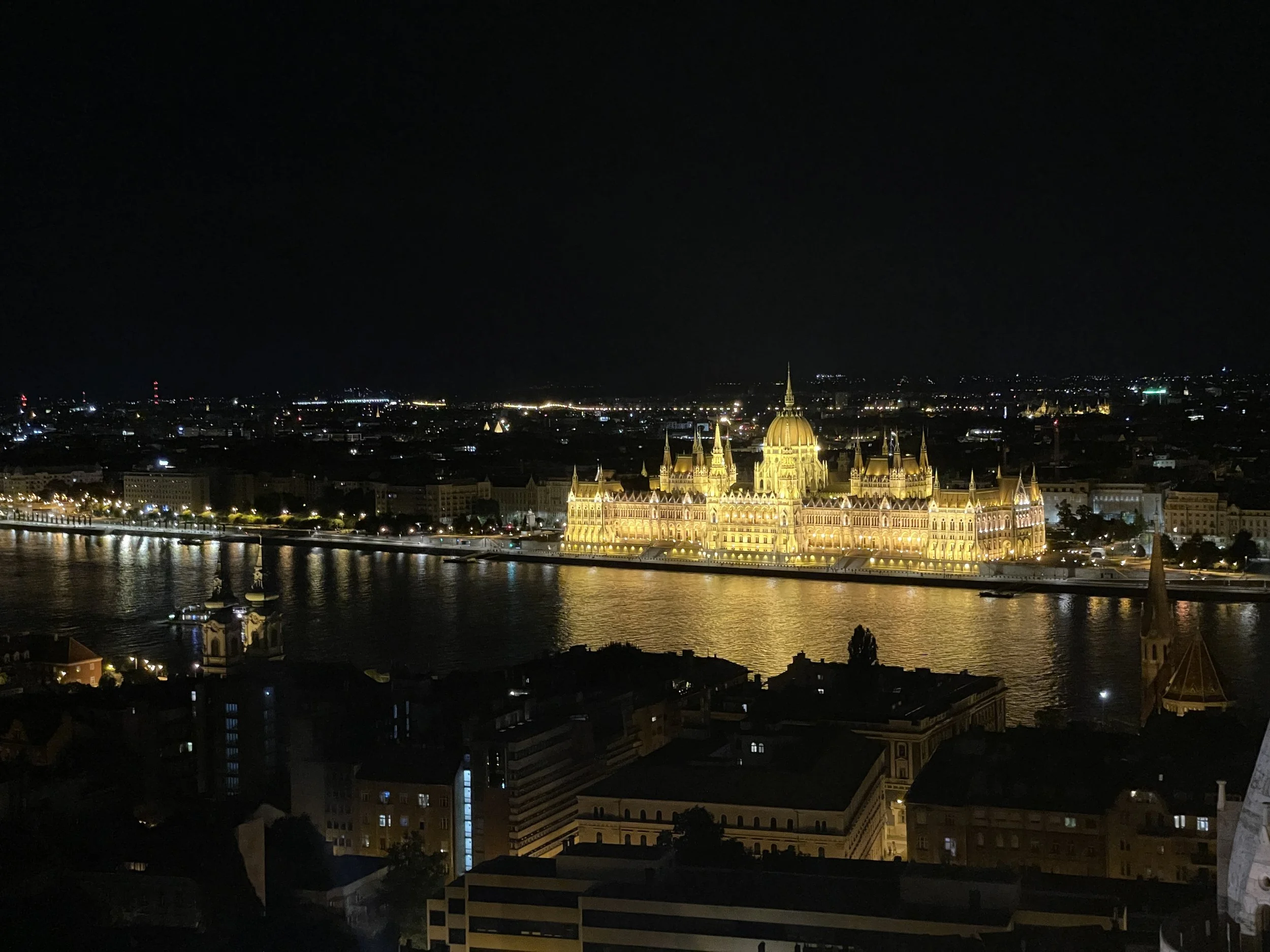
Nearby, we walked past the Hungarian Parliament Building, one of Budapest’s most iconic landmarks. Completed in 1904, it was designed in a Neo-Gothic style and remains the largest building in Hungary. Its grand façade, adorned with intricate spires, statues, and decorative arches, stretches along the banks of the Danube, making it an unmistakable centerpiece of the city. We didn’t stay long though, we were going to get a better view of it shortly.
After a quick gelato break and a stroll around St. Stephen’s Basilica, we headed back to the Danube River; this time, for a sunset cruise. Featuring great views, great company and all you can drink, what more could you want? This experience was recommended to me by a few friends before my trip, and I’m so glad they did.
As the boat set off, the city was glowing in the warm light of the setting sun. The Parliament Building gleamed along the riverbank, its spires and dome reflecting on the Danube, while Buda Castle stood high above the water on the other side. We went under the bridges connecting Buda and Pest.
The weather was perfect, the company was perfect, and the drinks were just as perfect. We met fascinating people from all over the world, swapping stories and sharing laughs as the city passed by on either side of the river.
By the end of the cruise, a few fellow traveller’s joined us to experience the Saturday-nightlife in Budapest. We ended up at a nearby bar for karaoke, belting out songs and having a great time. It was one of those nights where the city, the people, and the energy all aligned. A lively, spontaneous adventure that felt completely in tune with Budapest’s vibrant nightlife.
Along the way, hopping from bar to bar, we made a few new friends, including a mechanic for the McLaren F1 team.
Unfortunately, the distant thunderstorm from earlier in the day finally caught up to us. We walked our new friends back to their hotel, laughing at the absurdity of how much rain was coming down. Once they were safely inside, we realized we were still far from our own hotel, navigating the dark, partially flooded streets with no shelter in sight.
We eventually spotted a late-night cafeteria, a small, unassuming refuge amid the downpour. The food itself was less than impressive, but the warm shelter was exactly what we needed to recover from being soaked in shorts and short-sleeve shirts. For a few minutes, we could sit, shake off the rain, and enjoy a moment of respite before braving the streets again on the way back to our hotel.
By the time we got back, it was close to 4 a.m. Freezing and exhausted, it was still an incredible evening.
Day 3
Fully dry, we set out for our final day in Budapest, coinciding with the end of the F1 race weekend. One thing that stood out was how quiet the streets were during the days we were there. Despite the big event, most of the racing crowds seemed to leave the city, giving us extra space to explore. By contrast, evenings were lively and bustling, but during daylight hours, we could move through the streets, squares, and landmarks at a relaxed pace, enjoying the city without the usual weekend crowds.
Taking advantage of the quieter streets, we grabbed a quick breakfast before heading across the Széchenyi Chain Bridge toward Buda. Crossing the Danube, the contrast between the two sides of the city became immediately clear. Pest, where we had spent much of our stay, is flat, bustling, and full of wide boulevards, shops, and cafés.
Buda, on the other hand, is hillier and more residential, with winding streets, historic homes, and green spaces. From the bridge, the elevation and tree-lined streets of Buda hinted at a calmer, more scenic side of the city, a stark but complementary contrast to the energetic streets of Pest.
Winding up a steep, forested path, we eventually reached the top, where the trail led through the Castle Hill neighbourhood into the Labyrinth of Buda Castle. This underground network of tunnels and chambers stretches beneath the castle hill, with origins dating back to medieval times, when it was used for storage and military purposes.
Descending into the labyrinth, the atmosphere shifted. The stone walls closed in, the air grew cool and damp and the lighting was minimal. Some areas were slightly brighter, while others were illuminated by ominous blue lights, casting eerie shadows and shrouding statues in a creepy glow.
One section of the labyrinth was labeled “the Maze of Darkness”: a pitch-black passage with no lights at all. The only guide through the winding path was a thin rope stretched along the walls. Moving through it, the echoes of footsteps and faint ambient sounds made the experience both disorienting and immersive, a plunge into darkness within the historic underground tunnels.
It took some time, but we eventually made our way to the end of the maze- and we were greeting with a collection of statues, with soft music playing. Their stone eyes staring at our direction.
Outside the Labyrinth, overcast clouds hung overhead from storm the night before. We made our way to Matthias Church, a striking Gothic structure with a history stretching back to the 14th century. The church has been the site of royal coronations and significant historical events over hundreds of years.
Nearby, there was also a viewpoint overlooking Pest. The panorama was expansive: the flat city stretched out across the Danube. Even under the gray skies, the view highlighted the contrasting character of Buda and Pest. We then stopped for more Lángos, a bowl of beef cheek goulash, and chimney cake.
Walking south along the ridge, we eventually found ourselves at Buda Castle. Spread across the hilltop, the castle complex felt less like a single structure and more like a series of interconnected courtyards, museums, and terraces layered with centuries of history. Originally built in the 14th century, the castle has been destroyed, rebuilt, expanded and restored multiple times through wars and occupations, leaving it with an architectural mix that reflects the many eras Budapest has lived through.
Descending back toward the Pest side of the city, we found the streets suddenly packed with F1 fans. McLaren had won the Grand Prix that afternoon (obviously thanks to the positive vibes we’d given their mechanic the night before) and the celebration energy was unmistakable. Music spilled from pop-up stalls, people in team colors crowded the sidewalks, and the whole area felt like a spontaneous festival.
We stopped at a few booths along the way to test our reflexes, browse merchandise, and soak in the excitement. After a quiet, relaxed morning on the Buda side, the contrast was striking. Pest was buzzing, loud, and full of life. It felt like the city had flipped a switch, and we were catching the tail end of the weekend’s adrenaline.
We visited the Street Food Karavan - packed with vendors selling food, drinks and people, and fought our way to get more Lángos and other snacks.
Later in the evening, we decided to head back over to Buda to check out a hotel rooftop bar overlooking the Danube. A few of supercars lined the entrance, but the area outside was surprisingly quiet. Inside, we were quickly told the rooftop was closed for a private F1 after-party. Though, for 50€ each, they could let us in.
We hesitated, weighing whether it was worth it, and eventually walked away. Standing in the near-empty courtyard of Matthias Church, the four of us looked at each other and realized this was exactly the kind of moment we’d regret skipping. So we turned around, walked back to the hotel, paid the entry fee, and rode the elevator up.
The doors opened, and we were immediately handed glasses of champagne. The rooftop was buzzing with energy. We were joined by VIPs and people who clearly lived in a very different tax bracket than we did.
We did our best to blend in, chatting with a few interesting characters while taking in the view. The Hungarian Parliament was lit at first, its reflection shimmering on the Danube, and although the lights shut off shortly after we arrived, the atmosphere stayed electric. With helicopters flying overhead, music drifting up from the streets, and Budapest sparkling below, it genuinely felt like we had stumbled into a glimpse of another world . For one night, we got to be part of it.
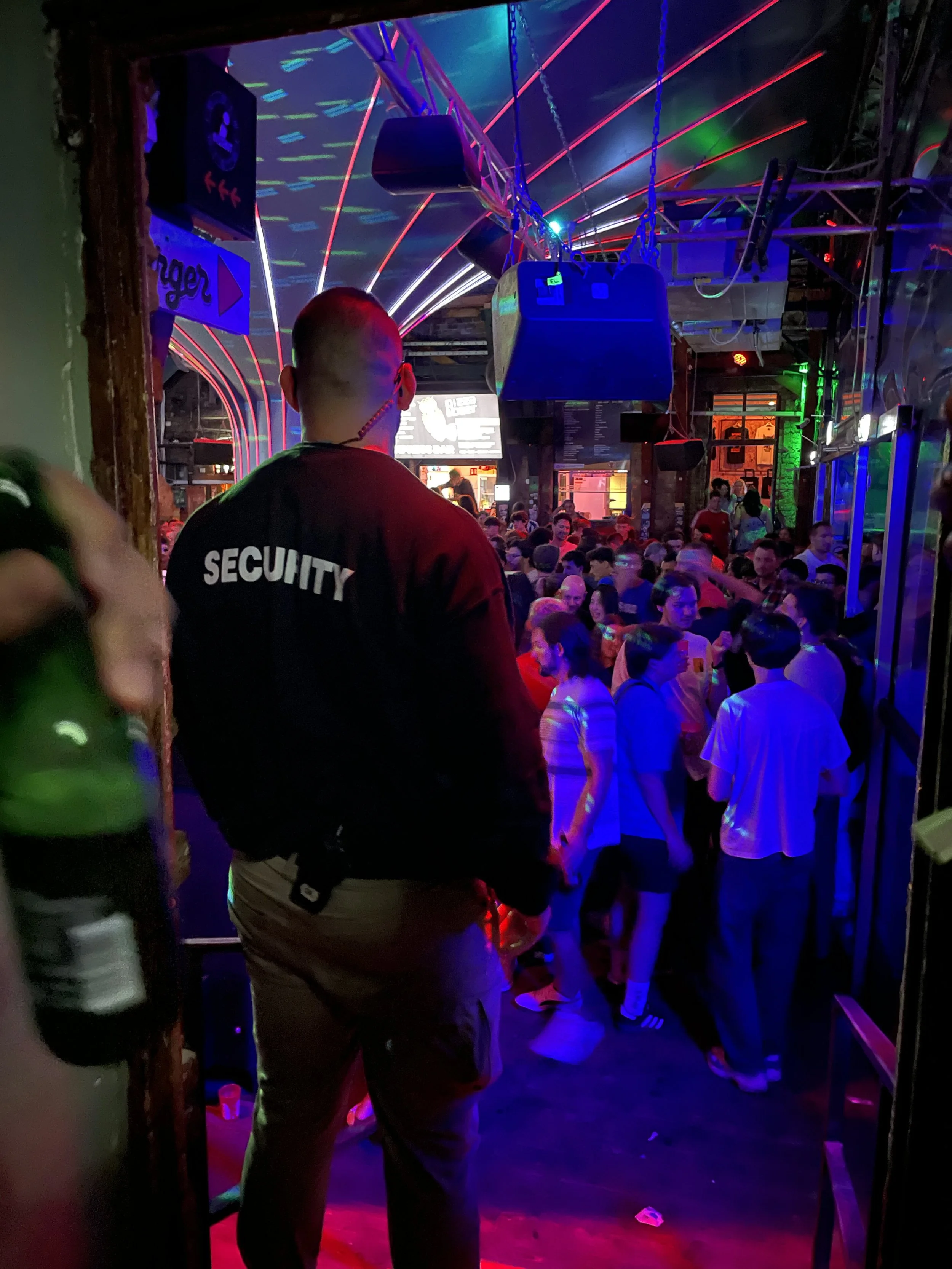
With one last stop of the night planned, we made our way to Instant–Fogas, one of Budapest’s biggest and most chaotic ruin-bar complexes. After the polished atmosphere of the rooftop party, stepping into Instant–Fogas was like diving straight back into Budapest’s wild, unfiltered nightlife.
Crowds squeezed past each other in narrow hallways, music from different rooms overlapped into a single chaotic soundtrack, and the energy was constant and loud. It was messy, lively and intense.
Day 4
Somehow, the trip had come to an end. We spent our final morning wandering through the streets, taking in a few last views and letting the city slow us down before we made our way to the train station for Vienna and, eventually, our separate flights home.
It was the kind of journey that felt full from start to finish. A mix of history, late nights, and thrilling moments that could only have happened because we were there together, in those exact places, at the right time. Budapest has a charm that’s hard to match, a blend of old-world character and modern energy that makes even ordinary moments feel memorable. Leaving it behind wasn’t easy, but it was the perfect finale to a trip we won’t forget.
More Photos of Hungary